The first issue in this argument is defining what actually is an alternative source of energy. In this article alternative energy sources will refer to renewable sources that will hope to replace fossil fuel burning methods that are not only harming the planet but have a very limited life cycle. The forerunners of the new renewable initiative are wind and solar power, which although not without their flaws are realistically the biggest prospects for a planet totally reliant on alternative energy sources. In the last few years the cost to produce and operate wind and solar farms can now compete with the burning of fossil fuels, and as a result many richer countries are investing more and more into what they think is a potentially subsidiary to unsustainable energy generation. Countries such as Norway have even managed to generate 98% of their energy from renewable sources, in contrast to counties such as the UK that generate just 12%; although that figure is set to increase in the near future. The fact is that in terms of generation alternative energy sources can evidently produce enough energy to supply a whole country, but for the world to run off of renewable energy there would still need to be a drastic change in the domestic and transportation uses. Cargo ships and aeroplanes are two imperative parts of modern life, yet are nowhere close to being ran off of renewable sources, and couple this with an increasing energy demand and in the near future the answer looks negative.
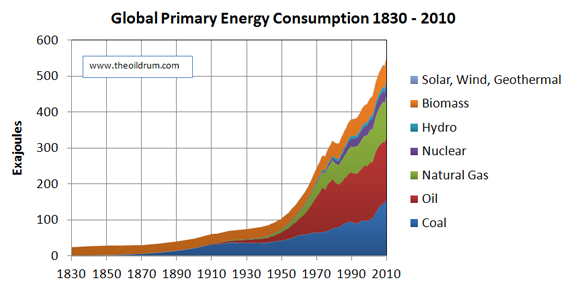
The global trend shows a world increasing in the reliance of fossil fuels.
At this current time alternative energy sources have some big disadvantages. The problems stem further than simply the immense cost to implement a system with even a hope of generating enough power, and rather ironically there is still the issue of renewables having a detrimental effect on the local environment. At this current time it's simply not true to claim that any energy generated is carbon neutral considering that the manufacturing of huge wind turbines is a process that requires a heavy emphasis on fossil fuels, and that's a rather minimal effect on the environment compared to say biomass, which would need approximately 10% of the world's total land area to generate enough energy on a global scale. To put that figure into perspective 10% of the world's land area is currently used for agriculture, and when you consider the environmental impacts of farming then you start to realise that alternative energy sources really aren't all that good. Other alternative methods don't get much better either. Hydroelectric power requires huge dams that destroy not only aquatic ecosystems but the whole surrounding area as well. Wind turbines are hugely expensive for their relative power output and murder anything that flies in the vicinity, generating a lot of noise in the process. Ethanol is a net energy loss that takes 70% more energy to produce than it can theoretically generate, and both tidal and geothermal are reliant on the local environment which doesn't make them a global solution.
Even after you go through the individual faults of each alternative method there is still the combined issue of reliability. Unlike fossil fuels alternative energy sources are not consistent, applying especially to wind and solar power that wouldn't be able to adapt to power influxes at times when wind and sunshine levels are at their lowest. It's no good saying we should simply store energy for these instances since we currently have no way of storing that amount of electricity, and you can't run on backup generators since they would be idle most of the time, and what business would want to operate a powerplant that's losing money the majority of the time? Even the richest governments on the planet would agree that financially that solution isn't sustainable in any way. In a world that relies on alternative energy sources there would be a high possibility of blackouts, and in modern society an event like that would be catastrophic.
You can't deny that despite their various downfalls, energy generated from fossil fuels have been very effective in the modern world, and getting nations to switch to alternative sources is a tall order.
An even bigger problem is trying to get the world to stop relying on the very effective and readily available fossil fuels. Sure the prices of fossil fuels will keep rising at a steady rate, but it's very hard to suddenly adopt a new energy strategy when you already have a system that's cheaper and more efficient. Why would a country such as Saudi Arabia want to switch to alternative energy sources when their economy practically runs off the oil industry? Abandoning the fossil fuel system would not only send various markets tumbling, but also lose national economies thousands of jobs. I'm not saying a gradual phasing of the global energy mix would necessarily be a bad thing, but to say the world can run solely on alternative sources is misguided. You try telling China, a country that burnt four billion tonnes of coal in 2012, that alternative energy sources would be a better solution for their ever expanding population, industry and economy. Telling British citizens that electric cars are better for the environment than their petrol powered equivalents did very little to increase sales, so why would the Chinese government think any differently? Electric cars out of interest are a very good way of showing the lethargic attitudes of the public towards alternative energy. Only 119,000 electric cars were sold in the US throughout the whole of 2014, by far the biggest global market for them, yet still dwarfed by the demand for cars powered on fossil fuels. Electric cars simply aren't ready to replace or even compete with conventional methods at this current time, and that's the same story with the majority of alternative energy schemes.
It's hard to imagine an overpopulated city in a poorer country reliant on alternative energy in the near future. The prospect simply isn't sustainable or appropriate technology for a developing country.
But the biggest problem by far is implementing alternative energy solutions into poorer countries. How a developing nation is supposed to switch to sustainable energy sources when they can barely manage with burning fossil fuels is something that needs to be addressed. The original question can quite simply be answered with a huge no if developing countries are taken into account, as alternative energy sources can only be funded by economically advanced countries with an already solid energy supply. Not only could poorer countries not afford huge fossil fuel saving schemes, but they don't have the ability to implement technology that is way too advanced and expensive to maintain. I'm not saying that it's impossible for less developed countries to make a contribution, and in fact countries such as Lesotho generate electricity solely through alternative methods, but unfortunately that's an anomaly caused by exceptional circumstances and only on a small scale. The reality is that fossil fuels are a necessity for developing nations, and governments in these areas have far bigger priorities than the threat of global warming.
Alternative energy sources are possible in developing countries, but nationwide programmes are very unlikely to be funded by governments that have other priorities with limited resources.
For alternative energy to become a global reality there would have to be a level of acceptance from both society and world powers. If there is no demand for initiatives such as electric cars or cleaner energy solutions then there is no hope of their even being widespread coverage. At this current time there are steps being taken so that more economically developed countries are creating a demand for this expanding industry, but the figures show that this method of generating power is still in the minority, and will continue to be until further research and refinement is undertaken. Even in the near future it's unlikely to see a shift towards alternative energy sources for personal transport, and despite the global trend increasing for these expensive product I have to conclude that in the near future there is no realistic chance that even the developed world could run on alternative energy sources alone. Statistics show that fossil fuel use was the same today as it was ten years ago. It seems that only when humanity does deplete the Earth of fossil fuels then a forcible change will be noticeable.
Musicals are an appeal that is lost on the likes of me. Prancing around in an unrealistic and pretentious fashion is anything but plausible, even if some of the films on this list manage to substitute this for some well executed scenes. To qualify for this list the film doesn't necessarily have to be a musical production, only that there are multiple songs performed by the cast that integrate themselves into the narrative. Don't expect 'The Beatles' or 'The Who' to make an appearance either, since I've deliberately excluded any concept albums that were adapted into films.
#10 West Side Story (1961) (5/10)
It took centuries, but finally somebody managed to make the story of 'Romeo and Juliet' actually interesting. The result was still far from being a perfect story, but where the acting and choreography let the film down there's always a masterful score to fall back on in all its gay and glorious form. It's hard to believe a heterosexual ever had a say on anything creative during the whole production thanks to cheesy love stories, outrageous clothing choices and the shittest gang rivalry ever conceived. Elton John could only dream of being this level of camp. There may be some serious themes being thrown around the place to try and make some of the story at least a little relatable, but in reality the whole film is just an excuse to have some of the most over-exaggerated dance sequences it's possible to imagine. It's an ethos that a person like myself just loves to hate, but all I can muster up is the thought that this production would have taken a lot of effort to pull off.
Audiences must have loved it though, as to this day this is one cool film to admit liking. Criticising the film in relation to musicals is almost a capital punishment in the more diverse areas of society, but it's easy to see why. The score is, as you would expect with a large budget musical, nothing short of excellent, and the choreography is mindblowingly complex. I guess that's why 'West Side Story' ended up winning ten Oscars for some reason. It's really not that good, and tends to get annoying quite fast, so what separates this musical from other musicals is still a big mystery to me. Still, at least it makes the work of William Shakespeare bearable in the modern age, and I would much rather watch this in an English lesson that those dreadful modern reenactments.
#9 My Fair Lady (1964) (6/10)
'My Fair Lady' will almost certainly be most notable to many for the now iconic performance of Audrey Hepburn, whose beautiful singing voice was actually dubbed rather disappointingly. Despite this manipulation there is no doubt that Hepburn's role as the innocent cockney girl whose life is beautifully transformed into a member of the upper classes is one for the ages. Rex Harrison also pulls his weight in the supporting role, and together these two create the atmosphere of a Victorian parlor game rather than the unsophisticated rabble that most musicals manage. 'My Fair Lady' is a film that would encourage you to gawp at the elaborate costumes rather than enjoying any of the songs, and although that's a brave thing to do in a musical, there is always an underlying love of musical theater that runs deep throughout the whole of this film.
The actual premise of the film is kept rather similar to the origins of a sophisticated George Bernard Shaw piece, which is an interesting reason to burst into song, but one that doesn't just shit on any literary heritage. In reality this serious formula shouldn't work, but as audiences discovered this is far more enthralling that what it might suggest on paper. At the time of release there may have been many who would of rather seen the much more talented Julie Andrews in the lead role, but Hepburn has a charm that can much more easily integrate into the well composed score and sweet narrative. A planned remake was thankfully shelved that would have seen Keira Knightly in the iconic role. A cancellation that would have pleased many in making sure that Hollywood decided against ruining an absolute classic.
#8 Fiddler on the Roof (1971) (6/10)
The film adaptation to the classic 1960's Broadway musical. 'Fiddler on the Roof ' is rather more serious than the conventional musical, clocking in at over three hours long and tackling social themes that other musicals would just show with a crappy dance instead. Surprisingly this musically derived film actually delivers as a decent serious drama, which although broken up with some tedious dancing and singing still creates a memorable narrative that rarely feels pretentious at all. The acting and directing are on par with many serious films of the same subject matter, which is a pleasant surprise from a musical that would usually translate itself into a ridiculous spectacle. For once a musical deserved its three Oscars. Not often do you get a film packed with fun and well written songs that only occasionally ends up becoming an absurdity. It's the least 'musically' musical on this list, and that's exactly why I like it so much.
#7 The Jungle Book (1967) (7/10)
A classic Disney film that manages to nicely combine some cheesy child friendly songs with some of that good old 'Disney magic'. 'The Jungle Book' is a childhood favorite of mine, and only seems to get better with age. As a musical based on a Rudyard Kipling novel this film should never contain any fun or excitement, but in traditional Disney style they forgot about the brutality of the original novel and took a more lighthearted approach to add a bit of cheer to a very dark concept. The result is a family favorite that features some of the most catchy and infectious songs Disney has ever come up with, sung by an eclectic mix of characters that are full of life and personality. Okay the songs aren't technical perfection, but for a big kid like myself they do an excellent job and never get in the way of the essential narrative. In reality I should hate Disney for butchering classic literature and for portraying an ecosystem were orangutans and tigers can coalesce, but for the last film that Walt Disney ever worked on the company managed to encapsulate what everyone loves best about Disney, plus a few little songs as a bonus.
#6 Singin' in the Rain (1952) (7/10)
'Singin' in the Rain' is a film that contains some of the most notable and iconic musical sequences in history. Gene Kelly literally singing in the rain has become a symbol for the energy and charisma required to pull off a successful musical, even if the song's originally lovely message has been tainted by the likes of Stanley Kubrick over the years. To this day 'Singin' in the Rain' is a classic that astounds viewers with its bubbly charm and well executed sequences. The effort that goes into each musical number is astounding, as is the choreography that even by today's standards looks totally polished and professional. This film is a charming romp through the world of classic Hollywood, at times feeling like a newborn puppy with bundles of energy and character that you can't hate despite numerous annoying downfalls. This classic is now regarded as one of the greatest American films of all time by many, and that's impressive for a musical that only found moderate success in its original run.
#5 The Lion King (1994) (9/10)
One of Disney's finest ever films that brought back the magic to a company that hadn't produced a properly good musical in decades. Admittedly the focus in this film is the drama, but the narrative is combined with multiple musical numbers to appeal to any human of any age. The score and musical composition were handled by the powerhouse duo of Elton John and Hans Zimmer, who by themselves are legends in film, yet alone when they worked together. The original plan was to have ABBA perform the music, but I'm glad they didn't. Would this film really have the same effect if the songs were just cheesy and camp pop songs recycled from the 1970's? Zimmer and John are phenomenal together and somehow manage to make the musical aspects of this epic just as memorable as the strong narrative, and despite many creative reshuffles before filming started the end products of both the music and animation are sublime by even Disney's high standards.
Some may argue that this film should be excluded from the list as there isn't an emphasis on musical numbers, but for me the narrative still revolves around the various memorable songs, even if they aren't present in every key scene. Elton John even claimed that the songs he wrote were widely accessible to all age ranges and were all inspired by 'The Jungle Book', and this similar style shows. At no point were any of the songs ever annoying, boring, meaningless, or in any way pretentious despite being pop songs aimed at appeasing children. This is an example of how an epic musical score can complement an epic film, so much so that the album has actually been certified diamond, which is an amazing achievement for an animated film. Disney is famed for including great songs within their classic films, but this was the one that really hit the mark.
#4 The Sound of Music (1965) (7/10)
Arguably the most famous musical on this list, thanks in part to a timeless performance from Julie Andrews who with this film cemented her role as the premier lead actress in any musical, especially if that musical revolves around the work of Rogers and Hammerstein. From the opening sequence, which may just be the most famous of any film ever, and through the variety of songs the cast and production team create an instant classic that borrows many aspects from older musicals and then takes them to the next level. The charming tale of the Von Trapp family, which in reality is actually really fucking dark, is brought to life with some innocent looking children and some orgasmically pretty shots of The Alps that take the focus of this musical away from the Nazis and more towards musical theater.
The thing is that upon first release this film wasn't at all popular with the critics, with some even claiming that the film was 'sentimental' and 'corny', which are actually fair points. Despite this backlash from critics the public loved it and it soon became the highest grossing film of all time, making 2.3 billion dollars at the box office when adjusted for inflation. Of course the film is now regarded as one of the most important films in cinema history, and that too was the reaction from the public at the time. This was the first American film to be completely dubbed in a foreign language, and the film was in such demand that the original release lasted for four and a half years. These astonishing statistics prove that this classic not only stood the test of time but became one of the all time greats in the process. Still, in my opinion there are far better musicals than this.
#3 Willy Wonka & the Chocolate Factory (1971) (8/10)
Okay I might be including a film that isn't really a musical at all on this list, but I thought the songs in this one were integrated brilliantly in what I consider an all time classic. Gene Wilder was a far better Willy Wonka than any Johnny Depp character, chiefly because Wilder has the ability to carry some epic numbers like the one featured above. Songs like that make Wonka seem like an eccentric genius, and the music helps the audience to enter this absurd fantasy land inhabited by lunacy around every corner. The score varies from morbidly dark to peculiar as does the content of the film, but this diversity adds to the intrigue around the whole premise. It's a film that's more mature than the traditional musical, one that substitutes cheap thrills for pure fantasy. It's a film that the child in me still remembers watching for the first time, and although it may have been disowned by original author Roald Dahl, it's still a film to make a song and dance over.
#2 The Wizard of Oz (1939) (8/10)
How could this delightful classic not make it into a high position on this list? 'The Wizard of Oz' has become an institute in Western popular culture over the last few decades despite originally being a disappointment at the box office. It didn't help that the film became the most expensive production at the time of release, but money it didn't make back during its original run has soon been made up for with its now immense popularity. Okay on paper it still looks a bit shit, but where the 1930's visuals don't impress the film makes up for with a bucketload of charm and colorful images. The lush landscapes are combined with some cheery and colourful songs that are almost timeless to the modern viewing public, even if they make you feel like an 80 year old in the process. I honestly don't care though. Huge orchestras make the film seem like a grand occasion upon every watch, which I suppose it very much is considering its lasting impact.
The film turned out to be so good that Pink Floyd decided to coincide their masterpiece 'Dark Side of the Moon' with the entirety of this film. Of course that's a hotly debated topic on a place called the internet, as is the common rumour that in the 'tin man sequence' there is a shot of a munchkin committing suicide in the background. Turns out the rumours surrounding this musical are actually just as mysterious as the magical landscape of 'Oz'. At the end of the day when you have a film with Judy Garland, a wicked witch, and enough LSD inspired bollocks to leave you scratching your head, it becomes a film that's impossible not to love, especially if you're a homosexual that idolises the story and musical theater in general. I wouldn't say this was the greatest example of cinematic perfection, but as musicals go they don't get much better than this all time classic.
#1 Oliver! (1968) (8/10)
I wasn't aware that a Charles Dickens novel could ever be converted into anything even slightly entertaining, but then that was before I saw what has to be one of the most entertaining films in history. But this is more than a film to put a smile on your face; it's also one that does it in bags of style. Somehow the quite brutal story of 'Oliver Twist' that centers on child labour in Victorian England is turned into a mesmerising concept set in a fantasy world that never at any stage feels unrealistic despite everyone breaking into song every now and then. The whole film is a con, filmed in middle class Surrey and containing some of the most lavish and extravagant scenes for even a musical, yet still manages to feel as realistic as a documentary. Unlike the monotonous work of Charles Dickens this film is packed with catchy numbers and interesting characters that vary from the frighteningly gripping Bill Sykes to the innocent charm of the protagonist.
For once a musical managed to ignore the memo about making every musical as cringey and absurd as possible, and instead leave some areas morbidly empty from any song and dance. The great narrative is coupled with musical masterpieces that instantly bring a smile to anyone's face, especially when you realise that the story is pretty top notch as well. Musicals in cinema never get this balance of a strong narrative and strong musical sequences, which although is certainly worthy of praise, is not worthy of a 'Best Picture Oscar'. That for me was going too far, but there's no doubting that this highly acclaimed musical is way ahead of its competitors on both scale and execution. The whole thing is like reading a Charles Dickens novel whilst on laughing gas, and that for me is what makes this production much better than iconic films such as 'The Wizard of Oz'.
This is the segment where I scour my favorite forums around the internet
and find some particularly interesting articles about current affairs
told in the words of my favorite human beings.
In this edition we have a student who believes he has the solution to why children are so unhappy. Unfortunately it turns out this becomes little more than a way to promote his own feelings that haven't even the slightest grip on reality.
___________________________________________________________________________________
https://www.wessexscene.co.uk/opinion/2015/08/25/why-is-our-government-making-british-children-unhappy/
___________________________________________________________________________________
Oh no, it's instantly obvious that this article will be based on feelings instead of factual evidence. I wouldn't be surprised if it was written by somebody who studies philosophy or some other similar subject that nobody has taken seriously since Ancient Greece, and now thinks that his knowledge will pass as factual evidence despite being total bollocks. Here we have an example of a student thinking that it's the government's moral obligation to eradicate bullying from schools to increase happiness, which although logical is simply not realistic. Bullying is always going to be present in not just schools, but society as well. Whether the reasons for doing so are personal gratification or just the human urge to feel better than others, there is always going to be tension and judgmental conflicts between two different individuals when one doesn't fit in like everyone else. It doesn't matter whether it's for being a homosexual, being a transgender child, or even for wearing glasses, the government should at no point start interfering in what kids are allowed to say and what they can't, especially when the result is branding adolescents with titles such as 'homophobe' and 'racist' that will stay with them for life.
And your source for all of this; why it's the famously reliable and not at all biased 'Daily Mail'. A journalistic source that sells copies by provoking reactions out of the public, so there is absolutely zero chance that any of your information cited has been fabricated in any way. It's also slightly worrying that your main source as to why British children are so unhappy is based on a 'global' study of just fifteen countries. Fifteen. That might indicate the primary data in your assumptions might not be reflective of the reality at all. I find this terrible use of statistics a poor reason to start blasting wild accusations at the government, especially when UNICEF, who let's face it are going to be more reliable than the 'Daily Mail', state that children's wellbeing is actually around average for Europe (https://www.unicef.org.uk/Images/Campaigns/ReportCard11_CYP.pdf). We have to ask is there any issue at all here?
Well this article was quick to pass judgment. Since when did bullying become exclusive to the homosexual community? I can assure you that many normal children also experience bullying, so why the parameters have suddenly become so specific is suspicious to say the least. These statistics might be relevant if you could prove that homophobia causes unhappiness in a significant portion of British children, but you can't. This suddenly looks like a poor excuse to shove your own biased agenda down my throat that doesn't in any way relate to the question. I'll agree that throwing money at something doesn't solve the issue, but that doesn't mean we should start dictating the lives of children in education, as that might end up creating a factory like environment, which you were so keen on highlighting in a previous paragraph. In my funny little world I thought refining the behaviour of children, or 'moulding individuals' as you put it, is exactly the same as a factory like system that you were criticising.
Then we arrive at another terrible use of statistics. 'Homophobic bullying has actually become the most severe'. I must have missed out on learning about the 'standard homophobia measurement system'. I've always stupidly assumed that you could only quantify objective measurements, but apparently it turns out homophobia is objective to philosophers. Maybe they should think a bit harder before using statistics as badly as that ever again, but then that level of thought might make them realise that philosophy is a huge waste of fucking time. Being as you're actually a philosopher I would also have expected you to have thought long and hard about the solution as well, but it turns out you think that highlighting homophobic behaviour and then telling children to stop doing it will work. I seem to recall that attitude of discouraging smoking and banning chewing gum did nothing to stop the problem in education, so I suggest painting a massive bullseye on the back of all homosexuals instead since they're all going to become bigger targets under your system.
Oh for fuck sake, here we go with this body positivity bollocks. Let me guess, you're one of those people who pose as leaders for diversity to try and make yourself look better, when in reality your false sense of sophistication is overshadowed by your blatant denial of how the world actually works. You actually believe that there isn't a link between image and personality. Bullshit: (http://www.ncbi.nlm.nih.gov/pubmed/7280161). And here comes that shitty source work again. This time it's a sitcom actor doing a documentary on BBC3, who are famous for spoonfeeding adolescents, but at least that's better than the fucking 'Daily Mail' again. These sources in no way explain how a so called 'perfect body' is in any way bad for children. What's wrong with having an aspiration that's healthy and looks attractive? It's ambitious for a reason, and a much better example than looking at some bed ridden bag of cholesterol that nobody will ever love because the fact is that people are judgmental. I admire you for trying to see through people's exterior, but a large part of me can't help but feel that in reality that's bollocks and you're just as judgmental in who you find attractive. That's how biology works, which must be a big step up for you considering that the discipline of biology relies on facts instead of subjective bollocks.
Again, this is just your feelings. You must be aware that in reality people are always going to be judgmental. Despite this, your solution to increase happiness with unhealthy people is censorship. Yes, without any causative evidence to back up this radical procedure, you think that showing children a well built human specimen as an example has an overall detrimental effect. Under your regime Calvin Klein will end up using repulsive models such as yourself to hopelessly try and advertise their products; and nobody wants to buy a product that's aimed at vile people like yourself. The study from the University of Kent that you cite says that average sized models 'could' have the same effect, and at no point suggests they're superior to their less realistic counterparts. Couple that with the evidence you have as to why we shouldn't have body standards is because it decreases happiness and your argument soon falls apart, not to mention that happiness can't be quantified. Other things that decrease happiness include losing a game of football, so shall we ban that as well while we get the chance. Yes, let's make all children's lives miserable to appease the minority who are currently unhappy, because in the spirit of your argument there is no better way to celebrate the individuality of students than by refining them even further.
Well that's an interesting conclusion considering that you still haven't provided any evidence that even links the government's obsession over grades to the wellbeing of students. Even more worrying is that your solutions towards curing the happiness of children are to implement the policing of language, censoring attractive bodies that don't reflect the average human, and allowing children to become unhealthy. No I'm sure those flawless procedures will have a dramatic effect on the happiness of children, even though you still haven't comprehended that happiness can't be measured. So no, don't listen to any of the bollocks in this article. More social elements in schools can fuck off. Keep teaching children actual facts that aren't some pretentious philosophy student's worthless feelings, especially when his solutions make Adolf Hitler look like the Virgin Mary. Why can't we just let children enjoy their childhoods without constantly interfering to dictate what's best for them?